- Kashif Khan
- Posts
- The Hepatitis B Story You Were Never Supposed to Hear
The Hepatitis B Story You Were Never Supposed to Hear
A vaccine given on day one of life—built on rushed studies, ignored warnings, and decades of unanswered questions.

Kashif Khan
December 10, 2025
Yesterday, I told you why newborns get the hepatitis B vaccine.
Today, let’s talk about something deeper:
What’s actually happened since this vaccine rolled out…
And why so many doctors and scientists raised alarms early on.
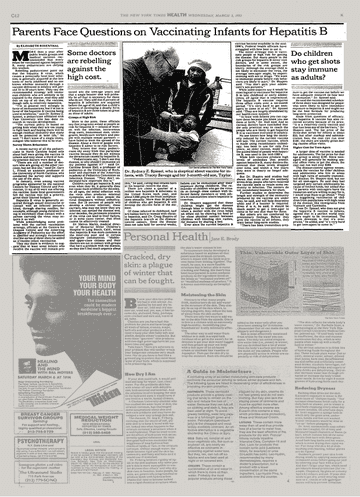
NY Times, 1993
The Vaccine That Sparked a Global Controversy
When the hepatitis B vaccine first hit the market, concerns surfaced immediately.
By the late 1990s:
France suspended school-based hepatitis B vaccination after thousands of reported autoimmune reactions (WHO)
U.S. congressional hearings revealed that infants were dying after the shot… while the number of infants actually at risk for hepatitis B was close to zero (official hearing from 1999)
Doctors testified that reported injuries were being denied, ignored, or drastically undercounted (National Vaccine Information Center)
And yet the program pushed forward.
Stories That Shook Lawmakers
Congress heard testimony from parents and healthcare workers describing what happened after vaccination:
A young boy who developed seizures, neurological disorders, and then autism (court testimony here)
A nurse who became unable to walk after chronic inflammatory demyelinating polyneuropathy (court testimony here)
A teenage girl whose life changed after autoimmune and neurological complications (court testimony here)
A father whose daughter died immediately after the shot (court testimony here)
These weren’t isolated anecdotes.
They were patterns that physicians had been seeing for years.
But they were dismissed as “unproven.”
Autoimmunity: The Evidence
From the beginning, researchers warned that hepatitis B antigens resembled human tissue—meaning the immune system could mistakenly attack the body.
For decades, officials denied the possibility.
Then a major study proved it:
That reactivity often lasted more than six months.
And it didn’t stop there.
Multiple studies found higher rates of:
multiple sclerosis
optic neuritis
rheumatoid arthritis
lupus
Guillain-Barré
chronic arthritis
various inflammatory disorders
In France, a surge in MS cases aligned directly with aggressive national hepatitis B vaccination campaigns.
These were published findings—not rumors.
And the weird part?
The original safety studies only monitored people for 4–5 days after injection.
A couple days is not nearly enough to declare the vaccine “safe.”
But still, the official line became:
“No evidence of harm.”
And of course there wasn’t—because no one looked.
When you look at the full history—not the marketing—you see a trail of unanswered questions.
At some point, we have to ask whether the problem is the vaccine itself…
Or a system that refuses to investigate its own mistakes.
Until next time,
Kashif Khan
These statements have not been evaluated by the Food and Drug Administration. This product is not intended to diagnose, treat, cure, or prevent any disease. Information on this site is provided for informational purposes only. It is not meant to substitute for medical advice from your physician or other medical professional. You should not use the information contained herein for diagnosing or treating a health problem or disease or prescribing any medication. If you have or suspect that you have a medical problem, promptly contact your regular healthcare provider.