- Kashif Khan
- Posts
- The $2 Billion Problem With Ozempic
The $2 Billion Problem With Ozempic
Vision loss, thyroid tumors, and stomach paralysis—the "miracle drug" is now at the center of one of the largest pharmaceutical lawsuits in recent history.

Kashif Khan
January 05, 2026
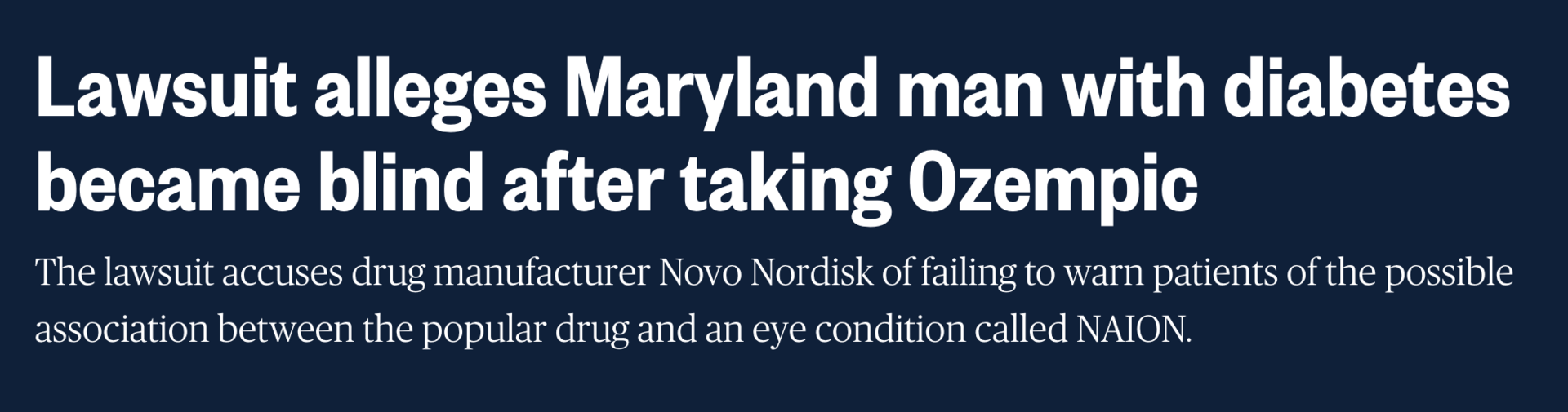
1,800+ lawsuits have now been filed against the creator of Ozempic (Novo Nordisk).
Legal analysts estimate total liability could exceed $2 billion.
The complaints?
Blindness, stomach paralysis, thyroid tumors, kidney damage, and more.
NBC News
I have been warning people about Ozempic since it came out.
In a newsletter I wrote May 2024, I said:
“Elon Musk, Oprah Winfrey, and several others have used Ozempic to lose weight. As with most things, some people get great results while others do not. One person will take it and get stomach paralysis. Another will take it and lose muscle that they won’t get back. A third person will take it, shed fat, and say it’s the best thing they ever did.”
They told you Ozempic was an easy fix.
Celebrities endorsed it, doctors prescribed it, and millions of people lined up to get it.
But here’s what they didn’t tell you… the risks.
Risk 1—Your Eyes
In July 2024, researchers at Harvard published a study that should have made headlines (link).
They found that people taking Ozempic for diabetes were 4x more likely to go blind from NAION—a "stroke of the optic nerve."
For people taking it for weight loss? The risk jumped to over 7x higher.
By June 2025, both the European Medicines Agency and the World Health Organization added NAION to the list of known side effects.
How does this happen?
The drug causes rapid blood sugar drops and quick weight loss.
This creates vascular stress that can starve the optic nerve of blood flow.
In Denmark, cases of NAION have more than doubled since Ozempic hit the market—from 67 per year to 148.
Risk 2—Your Thyroid
Here's something most people don't know:
Ozempic carries an FDA "black box" warning—the most serious warning the FDA can issue.
The reason?
In animal studies, semaglutide caused thyroid C-cell tumors, including medullary thyroid carcinoma.
That's a rare and aggressive form of thyroid cancer.
The FDA explicitly states that anyone with a personal or family history of medullary thyroid cancer should NOT take Ozempic.
Does your doctor ask about your family's thyroid cancer history before prescribing?
Most don't.
Risk 3—Your Gut
Gastroparesis. It means stomach paralysis.
Your stomach loses the ability to move food into your intestines.
You feel full after a few bites. Then nauseous. Then you can't eat at all.
Some people on Ozempic have developed gastroparesis so severe they've ended up in the emergency room.
Others now require feeding tubes.
The FDA updated the Ozempic label in 2023 to include ileus—a life-threatening intestinal blockage.
But by then, thousands had already been harmed.
Why Does This Keep Happening?
Here's the truth:
Pharmaceutical drugs almost never address the root cause of a problem.
They mask symptoms. And they always come with consequences.
Weight gain isn't a GLP-1 deficiency.
It's a symptom of deeper imbalances—hormonal dysfunction, insulin resistance, inflammation, poor detoxification, and genetic factors that determine how your body processes food and stores fat.
Until you understand WHY your body is holding onto weight, you're just playing whack-a-mole with symptoms.
I've worked with thousands of people who thought they needed a drug to lose weight.
What they actually needed was to understand their genetics—how their body uniquely processes carbs, fats, and hormones.
Once they had that roadmap, the weight came off. Without drugs. Without side effects. Without risking their eyesight or their thyroid.
There are no shortcuts to health. Only trade-offs.
Until next time,
Kashif Khan
These statements have not been evaluated by the Food and Drug Administration. This product is not intended to diagnose, treat, cure, or prevent any disease. Information on this site is provided for informational purposes only. It is not meant to substitute for medical advice from your physician or other medical professional. You should not use the information contained herein for diagnosing or treating a health problem or disease or prescribing any medication. If you have or suspect that you have a medical problem, promptly contact your regular healthcare provider.